
Digital SAT Transition Questions: 4 Error Patterns That Cost You Points
Digital SAT Transition Questions: 4 Error Patterns That Cost You Points
This guide is part of the complete Digital SAT Prep Guide.
Transition questions on the Digital SAT look deceptively simple. You see two sentences, a blank between them, and four familiar words — "However," "Furthermore," "For example," "Therefore." You pick the one that sounds right, move on, and lose the point. This pattern repeats three, four, sometimes five times per Reading & Writing module, and because the questions feel fast, most students never realize they are applying no real strategy at all. They are matching words to a vague feeling instead of reading the logical relationship between the sentences on either side of the blank.
The cost is significant. Transition questions appear in both Module 1 and Module 2 of the Reading & Writing section, which means errors here directly influence whether the adaptive algorithm routes you to the harder or easier second module. A student scoring in the 310–340 R&W section range who misses two or three transition items in Module 1 may never see the upper-difficulty questions that unlock 350+ territory. The issue is not vocabulary. The issue is that students default to sound instead of logic, and no amount of re-reading fixes a flawed decision process.
The 10-Second Method That Replaces Guessing
Most prep resources tell you to "learn your transition words." That advice is like telling someone who misses free throws to "learn what a basketball hoop looks like." You already know the words. The problem is the decision process you use to choose between them. Here is a concrete, repeatable method you can apply to every transition question on the test.
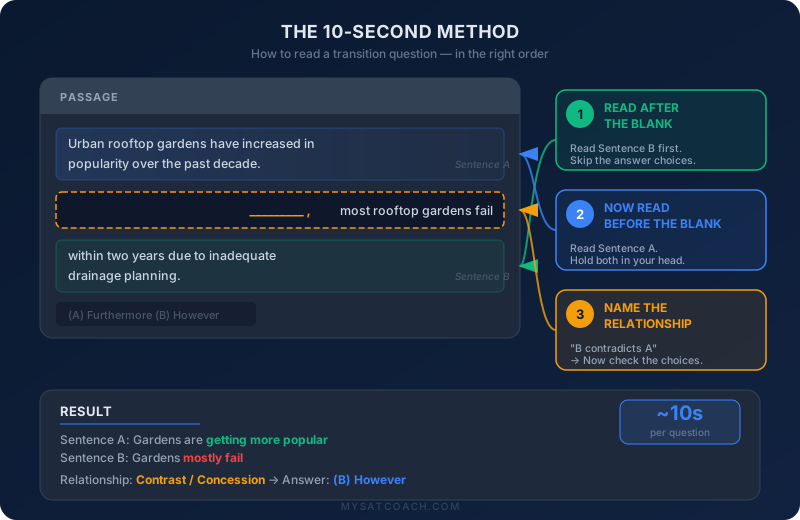
Step 1: Read the sentence after the blank first. This is counterintuitive — your eyes land on the sentence before the blank naturally, and the answer choices sit right there tempting you. Ignore both. Scroll down or shift your eyes past the blank and read the sentence that follows it. On the Bluebook testing interface, this sometimes means reading the last sentence of the passage before the middle, which feels wrong but is strategically correct.
Step 2: Now read the sentence before the blank. With both sides loaded into your working memory, you can see the relationship between them instead of predicting what the second sentence might say based on the first.
Step 3: Name the relationship out loud in your head before looking at any answer choice. Use plain language: "The second sentence gives a specific example of the first," or "The second sentence says the opposite of the first," or "The second sentence explains why the first is true." If you cannot name the relationship in one short phrase, re-read both sentences — you missed something.
This takes roughly ten seconds. Students who adopt this method report that transition questions shift from "I picked whatever sounded good" to "I knew the answer before I looked at the choices," because it forces you to identify the logical direction before any answer choice can anchor your thinking. Every error pattern described below is a failure of this method — a moment where the student skipped a step or substituted intuition for the three-step process.
Why Your Current Section Score Underestimates the Problem
Students scoring in the 310–340 R&W section range (on the 200–400 scale) often report that transition questions feel easy, even when their error maps show consistent misses in this category. The reason is straightforward: the wrong answer does not feel wrong at the moment you select it. Unlike a vocabulary question where an unfamiliar word signals difficulty, transition questions use common words that every student recognizes. The difficulty is invisible, which means the feedback loop that normally tells you to slow down never activates.
> Students rarely say "I struggle with transition questions." They say "I don't know why my R&W score won't move." That gap between perception and performance is exactly why these questions are so expensive.
If you are scoring between 300 and 340 on the R&W section, transition errors are likely costing you between 10 and 30 scaled points depending on how many appear in your specific test form. For a student targeting 350+, fixing this single question type can produce measurable score movement without touching any other skill area, because the fix is strategic rather than content-heavy — you do not need to memorize new material, you need to change how you process a decision.
Error Pattern 1: The Contrast Bias
The wrong approach is selecting "However" or "On the other hand" whenever the two sentences discuss different aspects of the same topic. Students see any shift in subject matter and interpret it as opposition, because contrast transitions are the most recognizable and frequently taught category. This is the error pattern that catches the widest range of scorers, from 300 to 370 on the R&W section.
This feels correct because almost every SAT prep resource drills contrast transitions hardest, creating a mental shortcut where difference equals contradiction. When you read a sentence about a novelist's early short stories followed by a sentence about her later novels, the shift in form and time period triggers the contrast reflex even though the sentences may be building on each other. Your brain registers "different thing" and reaches for "However" automatically.
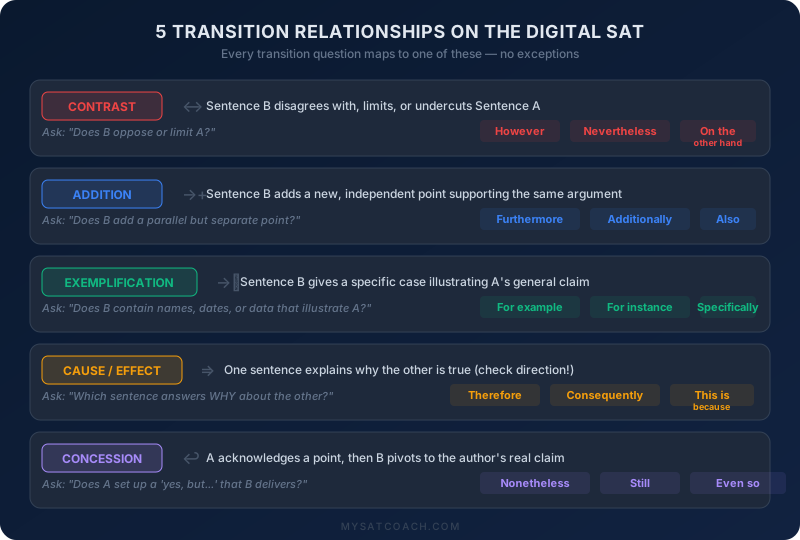
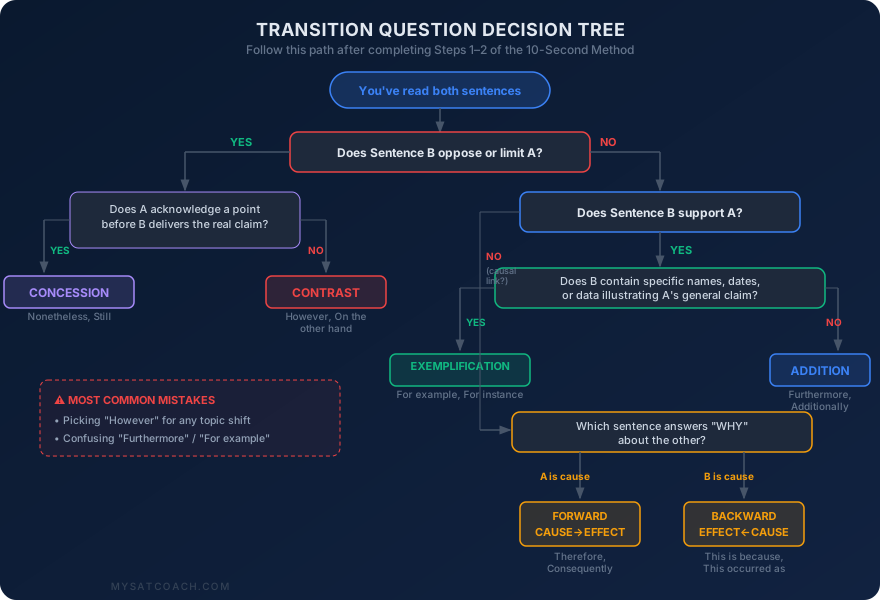
The right approach is to ask a single diagnostic question before choosing: does the second sentence disagree with, limit, or undercut the first? If the answer is no — if the second sentence simply adds new information, provides an example, or extends the first sentence's claim — then the relationship is not contrast regardless of how different the two sentences feel. Contrast requires logical opposition, not topical difference. If you find yourself thinking "well, it's kind of a contrast because they're talking about different things," that hedging is your signal that the relationship is not actually contrast.
Consider a passage where the first sentence states that a marine biologist's early research focused on coral bleaching in shallow reefs. The second sentence states that her later work expanded to include deep-water thermal vent ecosystems. You can feel the pull of "However" — shallow versus deep, early versus later, reefs versus vents. Everything about the surface content screams contrast. But the second sentence does not disagree with or limit the first. It extends the scope of the biologist's work. The correct transition signals addition or progression — "Subsequently" or "Building on this" — because the logical relationship is continuation, not contrast. The 10-Second Method catches this: when you name the relationship before looking at choices, you would say "the second sentence describes what she did next," which is continuation, not opposition.
Error Pattern 2: Ignoring the Sentence After the Blank
The wrong approach is reading only the sentence before the blank and selecting a transition based on that sentence alone. This is the single most common mechanical error on transition questions, and it happens because of how the Bluebook interface presents text. Your eyes move top to bottom. The blank appears partway through the passage. The answer choices appear directly below or beside the passage. Everything in the interface encourages you to process linearly and treat the blank as a decision point rather than a bridge between two ideas.
This feels correct because in normal reading, you build meaning forward — each sentence adds to what came before. The blank appears at a natural pause point, and your brain wants to categorize the relationship using the information it has already consumed. Looking ahead feels inefficient, especially when you are watching the clock in the upper-right corner of the Bluebook screen. The instinct is to pick quickly and move on, because the question "looks easy."
The right approach is Step 1 of the 10-Second Method: read the sentence after the blank before doing anything else. The transition word describes the relationship between two sentences, and you cannot identify a relationship with only one side of it. On the Bluebook interface, you may need to actively resist the pull of the answer choices, which are visually prominent. Some students find it helpful to use the highlight feature on the sentence after the blank first, forcing their eyes to register it before returning to the answer choices.
Imagine a passage where the sentence before the blank states that urban rooftop gardens have increased in popularity over the past decade. You read that sentence, feel good about the positive trajectory, and lean toward "Furthermore" or "In addition." But the sentence after the blank states that most rooftop gardens fail within two years due to inadequate drainage planning. The actual relationship is concession — the author acknowledges a positive trend and then immediately introduces a complicating reality. A student who read only the first sentence never sees the reversal coming, because the first sentence contains no signal of the shift that follows. This is not a hard question. It is a question that punishes a specific procedural shortcut.
Error Pattern 3: Confusing Addition With Exemplification
The wrong approach is treating "Furthermore" and "For example" as interchangeable when the second sentence provides specific evidence for a general claim made in the first. Students recognize that both transitions introduce supporting material and select whichever word appears first or sounds more natural, without distinguishing between the two logical functions. This error is especially common in the 330–360 R&W range, where students are accurate enough to avoid the obvious traps but not yet precise enough to split fine distinctions.
This feels correct because addition and exemplification both move in the same direction — they support the preceding sentence rather than opposing it. If you are using a gut-check approach, "Furthermore, the researchers found a 40% decline in bee populations" and "For example, the researchers found a 40% decline in bee populations" both sound grammatically correct and thematically appropriate. The emotional signal — "this sentence supports the last one" — is identical for both, which is why ear-based strategies cannot distinguish them.
The right approach requires a precise distinction that the 10-Second Method's Step 3 forces you to articulate. Addition introduces a new, independent point that supports the same broader argument. Exemplification introduces a specific instance, case, or data point that illustrates the immediately preceding general claim. Here is the diagnostic question: does the second sentence contain a specific name, location, date, or measurement that directly illustrates an abstract claim in the first? If yes, the relationship is exemplification. If the second sentence introduces a separate reason, a different finding, or a parallel argument, the relationship is addition.
Consider a passage where the first sentence claims that invasive plant species disrupt local ecosystems by outcompeting native vegetation. The second sentence states that kudzu, introduced to the southeastern United States in the 1870s, now covers an estimated three million hectares of forest. Notice the second sentence's fingerprints: a named species (kudzu), a geographic location (southeastern United States), a date (1870s), and a measurement (three million hectares). These are all concrete details illustrating the general claim above. The correct transition is "For example" or "For instance," not "Furthermore" or "Additionally," because kudzu is a case of the phenomenon described in the first sentence, not a separate point alongside it.
Error Pattern 4: Misreading Cause and Effect Direction
The wrong approach is selecting "Therefore" or "As a result" whenever two sentences describe a cause and an outcome, without verifying which sentence contains the cause and which contains the effect. Students correctly identify that a causal relationship exists but assign the direction based on sentence order rather than logical content. This pattern is the hardest to detect in your own work, because the reasoning feels complete — you identified the relationship type correctly but chose the wrong word because you assumed the standard cause-then-effect order.
This feels correct because in most expository writing, causes precede effects. Students internalize this convention and apply it automatically: the first sentence must be the cause, and the second must be the consequence. When the passage reverses this order — stating the effect first and the cause second — the student still selects a forward-causal transition and gets the item wrong despite having accurately identified that causation was the relationship type. It is the only error pattern where students are right about what the relationship is and still miss the question.
The right approach adds one layer to the 10-Second Method's Step 3. After you name the relationship as "cause and effect," ask a follow-up question: which sentence could answer a "why" question about the other? If the second sentence answers why the first sentence is true, the relationship is explanatory, and the correct transition will be something like "This is because" rather than "Therefore" or "Consequently." The word "therefore" means "for this reason, the following is true" — it points forward from cause to effect. If the passage runs effect-then-cause, "therefore" points the arrow in the wrong direction.
Consider a passage where the first sentence states that enrollment in a university's linguistics program doubled between 2019 and 2023. The second sentence states that the department hired three new faculty members and added a computational linguistics track in 2018. The dates tell the real story: the hiring happened in 2018, enrollment rose between 2019 and 2023. The effect (enrollment growth) appears first; the cause (expanded offerings, which predates the enrollment surge) appears second. A student who defaults to sentence-order causation selects "Therefore," implying that enrollment growth caused the hiring. But the chronology makes the causal direction clear — the second sentence explains the first. The correct transition signals backward causation, not forward causation.
What Your R&W Section Score Tells You About Next Steps
Your current R&W section score (on the 200–400 scale) indicates which layer of transition-question strategy to prioritize.
If you are scoring between 300 and 330 on the R&W section, you are likely making errors across multiple patterns described above, and Error Patterns 1 and 2 — contrast bias and sentence-skipping — are the highest-impact fixes. Your focus should be mechanical: drill the 10-Second Method until reading both surrounding sentences before choosing is automatic. Once that habit is locked in, the subtler error patterns become much easier to catch on your own.
If you are scoring between 330 and 360 on the R&W section, you are probably catching the obvious contrasts and continuations but losing points on the subtler distinctions — addition versus exemplification (Pattern 3) and cause-effect directionality (Pattern 4). Your practice should shift toward the diagnostic questions embedded in each pattern: "Is this a specific case or a new point?" and "Which sentence answers the why question?"
If you are scoring 360 or above on the R&W section, transition questions are unlikely to be your primary leak. Review your error map to confirm, and redirect your energy toward whichever R&W question type shows a higher miss rate. If transitions do appear in your error data at this level, the issue is almost certainly Pattern 4, which is the only pattern that consistently traps top-tier scorers because it requires a secondary diagnostic step beyond naming the relationship.
Where to Focus Next
If you are missing transition questions and scoring below 340 R&W: - Action: Take the MSC diagnostic to confirm that transitions are your highest-frequency error type, not just the one you noticed most recently - Read: Digital SAT Error Maps to see how transition errors interact with your other R&W weaknesses
If you are scoring 340–370 R&W and want to push higher: - Action: Take the MSC diagnostic to isolate whether your remaining R&W misses cluster in transitions, vocabulary-in-context, or rhetorical synthesis - Read: Digital SAT Words in Context to address the other high-frequency Expression of Ideas question type alongside transitions
If you are scoring 370+ R&W and transition errors still appear: - Action: Use the MSC diagnostic to verify the specific transition pattern causing errors — at this level, it is almost always directionality or concession logic - Read: Digital SAT Score Plateau at 1400 to determine whether R&W fine-tuning or Math gains offer the faster path to your target composite
Continue Your Digital SAT Prep
- Digital SAT Words in Context — the other Expression of Ideas question type that pairs with transitions in Module 1 difficulty routing
- Digital SAT Error Maps — see how transition misses fit into your full R&W error profile
- Digital SAT Score Plateau at 1400 — when R&W fine-tuning hits diminishing returns and Math strategy becomes the faster lever
Related Guides
- Bluebook Practice Tests: What They Tell You — how to extract transition-specific data from official College Board practice tests
- How the Digital SAT Adaptive Algorithm Works — why Module 1 accuracy on transitions directly affects your Module 2 difficulty tier
- 1200 to 1400 on the Digital SAT — the broader strategic framework for students in the score range where transition mastery has the highest marginal value
Frequently Asked Questions
How many transition questions appear on the Digital SAT? The Reading & Writing section typically includes three to five transition questions across its two modules. The exact count varies by test form, but they appear consistently enough that a pattern of errors here produces measurable score drag across multiple administrations. Because they appear in both Module 1 and Module 2, transition accuracy affects your adaptive routing, which amplifies the score impact beyond the individual items themselves.
Can I just memorize a list of transition words? Memorizing categories of transition words (contrast words, addition words, cause-effect words) gives you the vocabulary to name what you see, but it does not solve the core problem. The difficulty on these questions is never identifying what "however" means — it is identifying whether the passage relationship is actually contrast. Memorization without the 10-Second Method produces confident wrong answers, because you will select a word you recognize from the correct category while misidentifying which category applies.
Are transition questions harder in Module 2? Module 2 transition questions use more complex passage structures — longer surrounding context, more ambiguous relationships, and answer choices that differ by finer logical distinctions. The 10-Second Method remains identical, but the margin for imprecise reasoning shrinks. If you are routed to the harder Module 2, expect transition questions where two answer choices represent closely related but distinct relationships (such as concession versus contrast, or addition versus elaboration). This is where Pattern 3 and Pattern 4 errors become especially costly.
Should I spend extra time on transition questions or move quickly? The correct pace depends on your current error rate. If your diagnostic data shows that you are missing transition questions, spending an additional ten to fifteen seconds per item to execute the 10-Second Method is a worthwhile investment — that small time cost prevents errors that have outsized scoring consequences due to adaptive routing. If your accuracy on transitions is already high, maintain your current pace and allocate extra time to question types with higher miss rates. Time strategy should follow error data, not general rules about question difficulty.
What is the difference between "moreover" and "for instance" on the SAT? "Moreover" signals addition — it introduces a new supporting point that is independent of the specific claim in the preceding sentence. "For instance" signals exemplification — it introduces a concrete case that illustrates the preceding claim. The diagnostic question from Error Pattern 3 applies: does the second sentence contain specific names, dates, places, or measurements that directly illustrate a general claim in the first? If yes, the relationship is exemplification. If the second sentence introduces a separate reason or finding, the relationship is addition. This distinction is the one most frequently missed by students in the 330–360 R&W range.